 rus
rus


Column of Minpromtorg
Problems and Solutions
G. V. Samodurov, D. V. Lakhtyukhov
Russian Machine-tool Industry in 2025: Figures and Facts DOI: 10.22184/2499-9407.2026.43.2.18.27
The paper analyses the main economic indicators and development trends of the Russian machine-tool industry on the basis of statistical information collected and processed by the Association of manufacturers of machine-tool products "Stankoinstrument".
Russian Machine-tool Industry in 2025: Figures and Facts DOI: 10.22184/2499-9407.2026.43.2.18.27
The paper analyses the main economic indicators and development trends of the Russian machine-tool industry on the basis of statistical information collected and processed by the Association of manufacturers of machine-tool products "Stankoinstrument".
Tags: economic indicators export import and consumption of metalworking machine-tools and wtp machine-tool industry production импорт и потребление металлообрабатывающих станков и кпо производство станкоинструментальная отрасль экономические показатели экспорт
A. P. Kuznetsov, A. I. Belzetsky
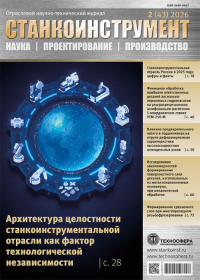
The Architecture of the Machine Tool Industry Integrity as a Factor in Technological Independence DOI: 10.22184/2499-9407.2026.43.2.28.38
This paper examines the integrity architecture of the machine tool industry as a key factor in ensuring its technological independence. The integrity of the industry is revealed through the forms, mechanisms and configurations that ensure the stability of the tripartite structure comprising the production, scientific-technical and infrastructure blocks. Based on the proposed methodological approach, a matrix of the architecture of integrity is formed, allowing the identification of interrelationships between forms and mechanisms, the assessment of their normative significance, and comparison with historical and technological dynamics. The findings obtained make it possible to refine the strategic guidelines for industrial policy aimed at ensuring technological sovereignty.
The Architecture of the Machine Tool Industry Integrity as a Factor in Technological Independence DOI: 10.22184/2499-9407.2026.43.2.28.38
This paper examines the integrity architecture of the machine tool industry as a key factor in ensuring its technological independence. The integrity of the industry is revealed through the forms, mechanisms and configurations that ensure the stability of the tripartite structure comprising the production, scientific-technical and infrastructure blocks. Based on the proposed methodological approach, a matrix of the architecture of integrity is formed, allowing the identification of interrelationships between forms and mechanisms, the assessment of their normative significance, and comparison with historical and technological dynamics. The findings obtained make it possible to refine the strategic guidelines for industrial policy aimed at ensuring technological sovereignty.
Tags: integrity integrity architecture level machine tool industry technological independence technological sovereignty архитектура целостности станкоинструментальная отрасль технологическая независимость технологический суверенитет уровень целостность
News
Materials Machine Tools
E. M. Zakharievich, V. V. Lapshin, M. A. Shavva, G. A. Sudin, A. N. Shevchenko
Finishing of the Most Critical Components of Axial Piston Hydraulic Pumps on an Ultra-Precision 5 axis Grinding and Boring Machine UTM 250-M DOI: 10.22184/2499-9407.2026.43.2.40.48
This paper describes the UTM 250-M ultra-precision 5 axis grinding and boring machine, primarily designed for machining the most critical surfaces of axial piston hydraulic pump components. It describes the technology implemented on the machine for machining cylindrical plunger surfaces and drum bushing mating surfaces, ensuring micrometric dimensional accuracy, eliminating selective part selection and ensuring complete interchangeability. Additional machine retooling capabilities for machining components such as swash plate, support for swash plate, and slippers are demonstrated. The achieved precision and quality parameters are presented for each component type.
Finishing of the Most Critical Components of Axial Piston Hydraulic Pumps on an Ultra-Precision 5 axis Grinding and Boring Machine UTM 250-M DOI: 10.22184/2499-9407.2026.43.2.40.48
This paper describes the UTM 250-M ultra-precision 5 axis grinding and boring machine, primarily designed for machining the most critical surfaces of axial piston hydraulic pump components. It describes the technology implemented on the machine for machining cylindrical plunger surfaces and drum bushing mating surfaces, ensuring micrometric dimensional accuracy, eliminating selective part selection and ensuring complete interchangeability. Additional machine retooling capabilities for machining components such as swash plate, support for swash plate, and slippers are demonstrated. The achieved precision and quality parameters are presented for each component type.
Tags: axial piston hydraulic pumps cylinder block diamond turning plunger precision boring precision grinding аксиально-поршневые гидронасосы алмазное точение блок цилиндров плунжер прецизионное растачивание прецизионное шлифование
I. A. Zverev, G. A. Chemel
The Effect of Pre-Load in Bearings on the Elastic-Deformation Characteristics of High-Speed Spindle Assemblies DOI: 10.22184/2499-9407.2026.43.2.50.58
The results of theoretical and experimental studies of the elastic-deformation characteristics of high-speed spindle assemblies on radial ball bearings, which are widely used in high-precision spindle assemblies, are presented. The main principles adopted in development of a mathematical model of high-speed spindles are presented, taking into account the method of creating preload in the spindle supports. A specialised software module has been developed in MATLAB for the practical implementation of the model. The patterns of influence of rotational speed, bearing temperature, and the magnitude and method of creating preload in the supports on the characteristics of a high-speed spindle have been confirmed.
The Effect of Pre-Load in Bearings on the Elastic-Deformation Characteristics of High-Speed Spindle Assemblies DOI: 10.22184/2499-9407.2026.43.2.50.58
The results of theoretical and experimental studies of the elastic-deformation characteristics of high-speed spindle assemblies on radial ball bearings, which are widely used in high-precision spindle assemblies, are presented. The main principles adopted in development of a mathematical model of high-speed spindles are presented, taking into account the method of creating preload in the spindle supports. A specialised software module has been developed in MATLAB for the practical implementation of the model. The patterns of influence of rotational speed, bearing temperature, and the magnitude and method of creating preload in the supports on the characteristics of a high-speed spindle have been confirmed.
Tags: elastic-deformation characteristics of the spindle high-speed spindle assembly mathematical model radial-thrust ball bearing высокоскоростной шпиндельный узел математическая модель радиально-упорный шарикоподшипник упруго-деформационные характеристики шпинделя
Materials processing technologies
E. O. Shevchuk, A. N. Rykunov, D. A. Konovalov
A Study of the Patterns Governing the Formation of the Surface Layer of Components Made from Metal-Filled Polymers During Mechanical Processing DOI: 10.22184/2499-9407.2026.43.2.60.62
A dependence of surface roughness on the machining parameters of metal-filled polymers using a flexible tool with a ceramic bristle has been identified. The machining parameters at which the roughness reduction of the machined surface is observed have been determined, and the optimal machining parameters for achieving the required roughness value have been identified.
A Study of the Patterns Governing the Formation of the Surface Layer of Components Made from Metal-Filled Polymers During Mechanical Processing DOI: 10.22184/2499-9407.2026.43.2.60.62
A dependence of surface roughness on the machining parameters of metal-filled polymers using a flexible tool with a ceramic bristle has been identified. The machining parameters at which the roughness reduction of the machined surface is observed have been determined, and the optimal machining parameters for achieving the required roughness value have been identified.
Tags: additive manufacturing machining machining conditions metal-filled polymers polymer composites surface roughness аддитивные технологии металлонаполненные полимеры механическая обработка полимерные-композиционные материалы режимы механической обработки шероховатость поверхности
Yu. P. Rakunov, V. V. Abramov, A. Yu. Rakunov
Modernization of High-Tech Production Facilities by Digital Transformation of Group Technology. Part 1 DOI: 10.22184/2499-9407.2026.43.2.64.71
The paper discusses the methodology for creating a system of multi-level basic group technology, using top-down and bottom-up design of group technological processes (GTP) by the method of «analysis-synthesis» of design and technological information. The use of the synthesis method to solve the problem of sorting through technically possible options for integrated transitions, positions and settings on the control panel with the correct filling of matrix tables by a semi-skilled technologist makes it possible to obtain technological processes that are optimal for modern production of mechanical group processing of precision turned parts of any shape. The advantages of the proposed approach compared to traditional ones are a significant increase in the quality of the developed technology and a sharp reduction in the time required for technological preparation of mass production.
Modernization of High-Tech Production Facilities by Digital Transformation of Group Technology. Part 1 DOI: 10.22184/2499-9407.2026.43.2.64.71
The paper discusses the methodology for creating a system of multi-level basic group technology, using top-down and bottom-up design of group technological processes (GTP) by the method of «analysis-synthesis» of design and technological information. The use of the synthesis method to solve the problem of sorting through technically possible options for integrated transitions, positions and settings on the control panel with the correct filling of matrix tables by a semi-skilled technologist makes it possible to obtain technological processes that are optimal for modern production of mechanical group processing of precision turned parts of any shape. The advantages of the proposed approach compared to traditional ones are a significant increase in the quality of the developed technology and a sharp reduction in the time required for technological preparation of mass production.
Tags: analysis-synthesis method design automation digital transformation digital twin of the enterprise internet of things multi-level basic technology top-down and bottom-up design автоматизация проектирования интернет вещей метод «анализа-синтеза» многоуровневая базовая технология нисходящее и восходящее проектирование система менеджмента и управления качеством цифровая трансформация цифровой двойник предприятия
Tools and Tool Systems
O. V. Malkov
Formation of the Uncut Chip Layer During Multi-Pass Thread Milling DOI: 10.22184/2499-9407.2026.43.2.72.79
This paper presents the results of modelling for the chip layer formation during multi-pass thread milling. The patterns identified can be used to derive analytical relationships for the parameters governing chip layer formation and to interpret the results of experimental studies on multi-pass thread milling.
Formation of the Uncut Chip Layer During Multi-Pass Thread Milling DOI: 10.22184/2499-9407.2026.43.2.72.79
This paper presents the results of modelling for the chip layer formation during multi-pass thread milling. The patterns identified can be used to derive analytical relationships for the parameters governing chip layer formation and to interpret the results of experimental studies on multi-pass thread milling.